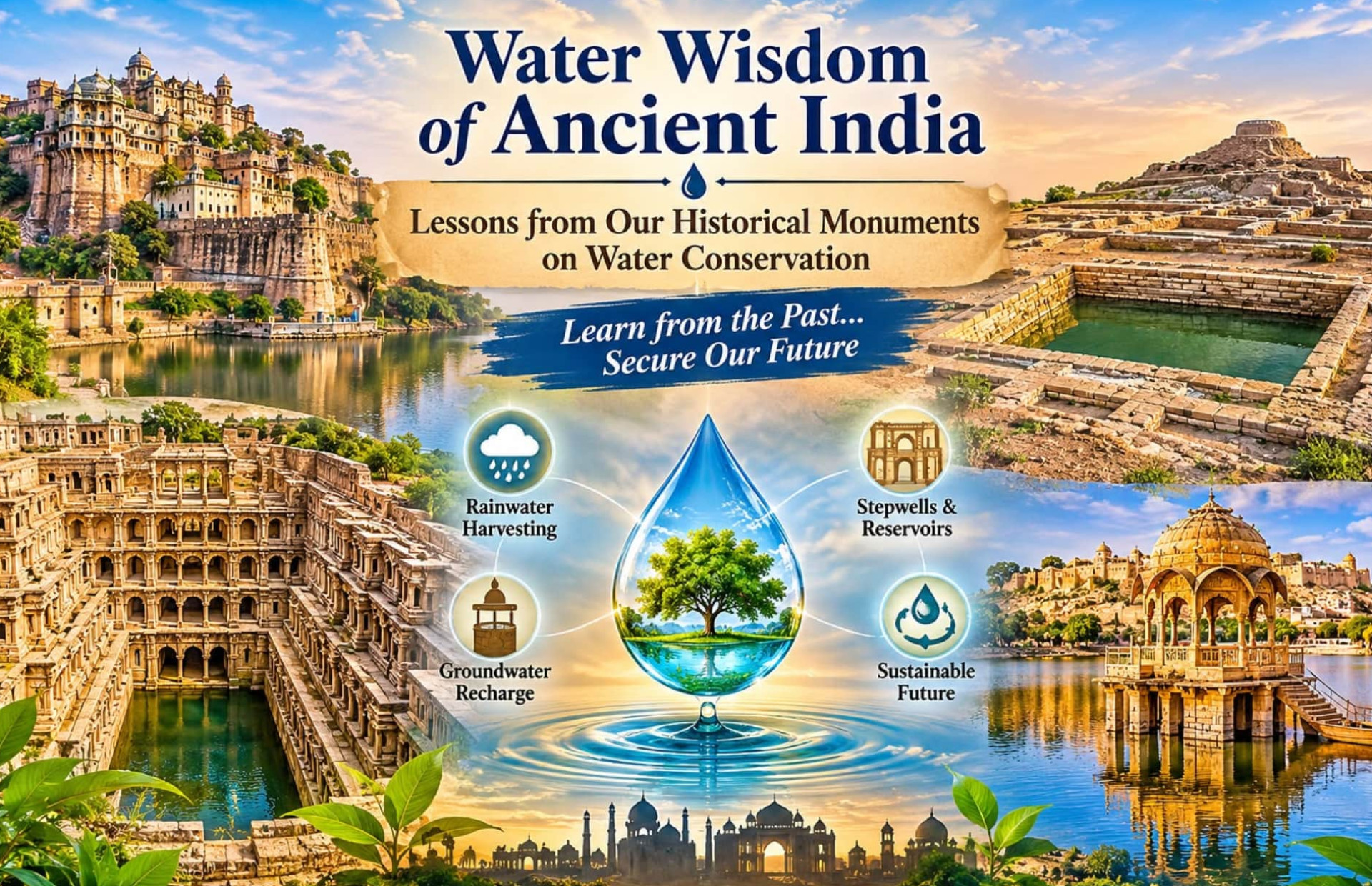
Water Wisdom of Ancient India: Lessons from Our Historical Monuments on Water Conservation
Water Wisdom of Ancient India: What Our Historical Monuments Can Teach Us About Saving Water Today
An insightful journey through India’s ancient water conservation systems and the lessons they hold for a water-secure future.
India has faced droughts and water shortages for centuries. Yet, long before modern dams, pipelines, water tankers and municipal water supply systems existed, our ancestors had already developed remarkable ways to collect, store and conserve water.
Our kings, queens, engineers and communities understood one important thing: Water conservation is not just about saving water; it is also about collecting it, storing it and replenishing the natural sources from which we get it.
Across India, historical monuments, forts, stepwells, lakes and ancient cities stand as evidence of this traditional knowledge. These structures were not built only for architectural beauty. Many were designed to support communities and provide water during difficult times.
How Ancient India Conserved Water Through Architecture
Consider Chittorgarh Fort in Rajasthan. Today, visitors admire its magnificent palaces, temples and historical architecture. However, another remarkable story lies within its walls.
The fort is traditionally associated with 85 water bodies, including reservoirs and ponds. These rainwater harvesting structures played an important role in sustaining its population, particularly during periods of drought and water scarcity.
Similarly, Rani Ki Vav in Gujarat, a UNESCO World Heritage Site, demonstrates how our ancestors developed sophisticated underground stepwell systems. These structures provided access to groundwater while also serving as important community spaces.
At Dholavira, one of the prominent ancient Harappan cities in Gujarat, people developed an extensive network of reservoirs, channels and water management structures to collect rainwater and seasonal stream water. Its sophisticated water management system reflects the engineering knowledge of the Indus Valley Civilisation.
In the desert city of Jaisalmer, Gadisar Lake became an important source of water for the local population. In Bundi, Rajasthan, traditional stepwells, locally known as baoris or baolis, helped communities access and preserve water, particularly during dry periods.
These examples reveal an important lesson: Our ancestors did not simply depend on whatever water was available. They planned ahead and developed systems to secure water for the future.
India’s Modern Water Crisis: Are We Only Talking About Saving Water?
Today, water conservation has become an urgent concern across India.
Municipal corporations, government departments and local authorities regularly appeal to citizens to use water carefully, avoid wastage and conserve the water stored in reservoirs.
These efforts are necessary. However, we must ask another important question:
While we are trying to save the water already stored, what are we doing to ensure that more water gets stored for the future?
Changing rainfall patterns, growing populations, increasing urbanisation and rising water demand are putting pressure on our existing water resources.
Depending only on dams, reservoirs and municipal water supplies cannot be a sustainable long-term solution.
We need to focus equally on rainwater harvesting, groundwater recharge and the restoration of traditional water bodies.
Concrete Development Versus Groundwater Recharge
One of the biggest challenges in modern cities and villages is excessive concretisation.
Roads, footpaths, parking spaces, residential complexes and open areas are increasingly covered with cement and concrete.
Although these developments improve infrastructure, they also reduce the natural surfaces through which rainwater can enter the soil.
When rainwater flows over concrete surfaces and directly into drainage systems, a valuable opportunity to replenish groundwater is often lost.
This affects the natural recharge of wells, borewells and underground water sources.
Development is necessary, but it should not come at the cost of our natural water resources.
Traditional Water Conservation Methods We Can Revive
We have modern technology and engineering knowledge, but many traditional water conservation principles remain relevant even today.
Some practical measures include:
1. Rainwater Harvesting
Collect rainwater from rooftops and direct it into storage tanks or scientifically designed groundwater recharge systems.
2. Percolation Pits
Create properly designed pits with suitable filter materials that allow rainwater to seep into the ground.
3. Recharge Wells
Direct filtered rainwater towards suitable underground aquifers to help replenish groundwater levels.
4. Permeable Surfaces
Use water-permeable materials in suitable open areas, pathways and parking spaces instead of covering every surface with concrete.
5. Restoration of Traditional Water Bodies
Protect and revive old lakes, ponds, stepwells and village tanks. These traditional systems can continue supporting local communities when properly maintained.
These measures require scientific planning, suitable local groundwater assessment and regular maintenance. They are not merely construction activities; they are investments in future water security.
What Can Modern India Learn From Its Ancestors?
There is an important difference between the way our ancestors approached water and the way we often approach it today.
They understood that water conservation had to be part of everyday life, community planning and architecture.
A fort needed reservoirs. A desert city needed a lake. A village needed wells and ponds. A community needed systems to collect and preserve every possible drop of rainwater.
Today, we have better technology, modern infrastructure and advanced engineering knowledge. We should use these advantages to improve traditional systems rather than forget them.
Our historical monuments should not remain just tourist destinations. They should also become learning centres that remind us of India’s traditional environmental wisdom.
When we visit these places, we should look beyond their beauty and understand the knowledge, planning and community effort behind their creation.
Water Conservation Is Everyone’s Responsibility
Water conservation cannot be the responsibility of municipal corporations and government departments alone.
Government authorities can build reservoirs, introduce regulations and promote rainwater harvesting. Municipal corporations can encourage groundwater recharge systems. Organisations can support water conservation initiatives.
But citizens also have an equally important responsibility.
We must:
* Stop unnecessary wastage of water.
* Encourage rainwater harvesting in homes, schools and workplaces.
* Protect local ponds, lakes and natural water bodies.
* Support groundwater recharge initiatives.
* Promote responsible construction and urban planning.
* Educate children and communities about sustainable water management.
Most importantly, we must move beyond the idea that water conservation means simply using less water.
We must save what we have, harvest what nature gives us and replenish what we take from the earth.
A Journey Into India’s Past, A Lesson for Our Future
At Sahyogmantra Tours, we believe that travelling is not only about discovering beautiful destinations, historical monuments and different cultures. It is also about understanding the stories, knowledge and wisdom that our country carries.
India’s historical destinations offer much more than beautiful architecture and memorable travel experiences. They reflect the engineering, environmental understanding and foresight of generations before us.
The next time you visit Chittorgarh Fort, Rani Ki Vav, Dholavira, Gadisar Lake or the historic stepwells of Bundi, take a moment to look beyond their beauty.
Think about the people who designed these structures, the communities they supported and the generations that benefited from their vision.
They planned for water even when it was not raining.
Perhaps the most important question for our generation is not whether we have enough water today, but whether we are doing enough to ensure that future generations will have water tomorrow.
Explore India’s heritage. Understand its wisdom. Protect its future.
Discover India with Sahyogmantra Tours – Explore the world in comfort.